
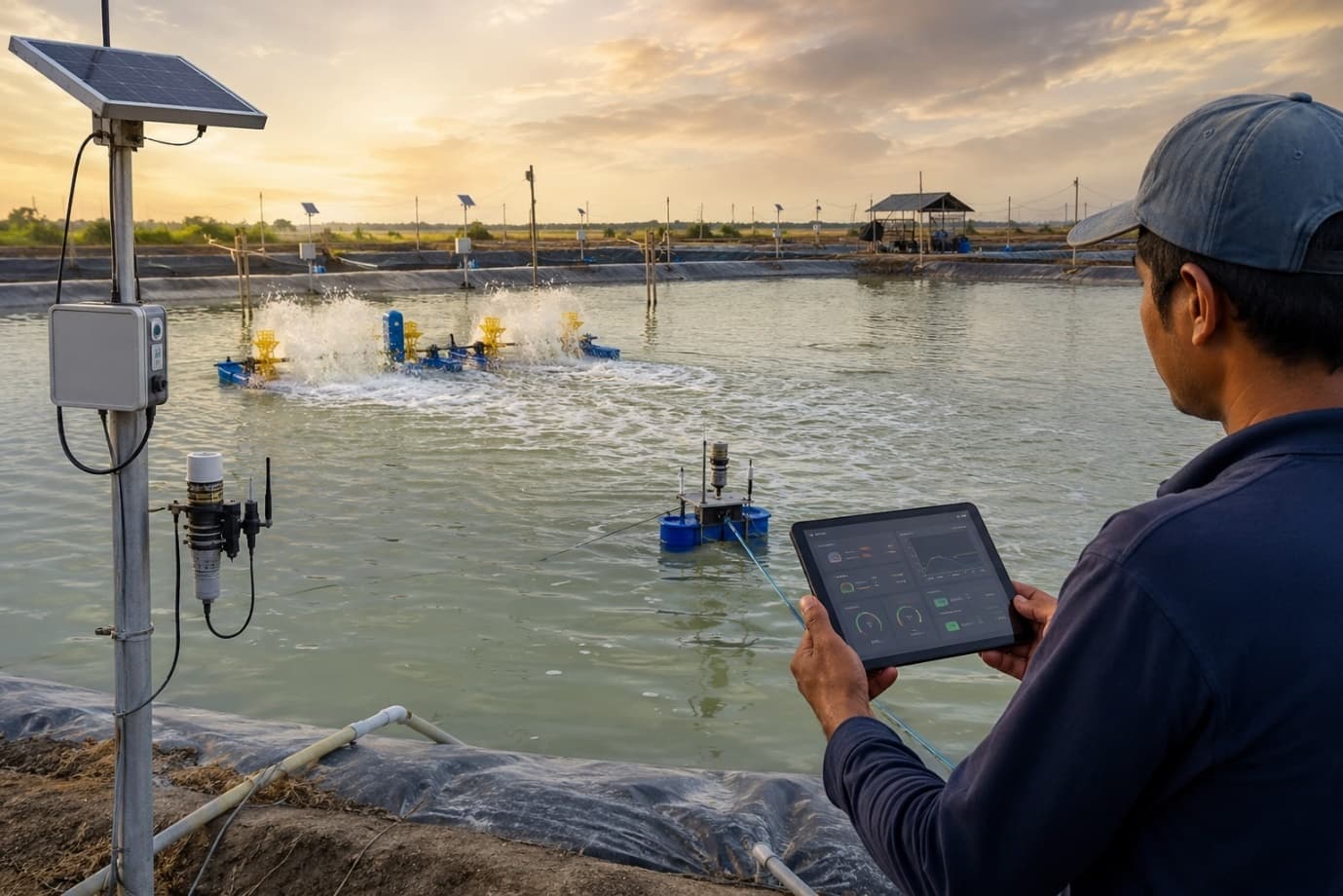
Shrimp farming has come a long way from relying solely on experience and manual observation. Today, technology is transforming aquaculture into a more efficient, data-driven, and sustainable industry. Farmers are no longer making decisions based only on visual inspections or intuition. Instead, they are using sensors, artificial intelligence, automation, and digital tools to monitor pond conditions in real time and make faster, more accurate decisions.
This shift towards smart shrimp farming is helping producers improve productivity, reduce risks, lower production costs, and increase profitability. As India's shrimp industry continues to grow, technology is becoming an essential part of modern farm management rather than an optional investment.
Why Shrimp Farming Needs Technology
Shrimp farming is influenced by many factors that change every day. Water quality, temperature, dissolved oxygen, pH, salinity, feed management, weather conditions, and disease risks all affect shrimp growth and survival.
Traditionally, farmers relied on routine pond inspections and manual water testing to monitor these parameters. While experience remains valuable, modern shrimp farms are becoming larger and more intensive, making continuous monitoring increasingly important.
This is where aquaculture technology is changing the industry. By collecting real-time data and providing instant alerts, technology helps farmers respond quickly before small problems become major losses.
AI in Shrimp Farming
One of the most exciting developments is the use of AI in shrimp farming.
Artificial Intelligence (AI) can analyse large amounts of farm data, identify patterns, and provide recommendations that help farmers improve decision-making.
AI-based systems can monitor:
- Feeding behaviour
- Water quality changes
- Growth performance
- Oxygen fluctuations
- Disease risk indicators
- Weather conditions
Instead of reacting after problems occur, farmers can take preventive action based on AI-generated insights.
As AI continues to improve, it is expected to become one of the most valuable tools in modern aquaculture.
Smart Technology for Shrimp Farms
Modern smart technology for shrimp farms combines multiple digital tools into one integrated management system.
Today's farms can use:
- Automatic feeders
- Water quality sensors
- Aeration controllers
- Mobile farm management apps
- Cloud-based monitoring systems
- Smart cameras
- Weather monitoring stations
These technologies reduce manual work while improving the accuracy of farm management.
Farmers can monitor pond conditions from their smartphones without needing to visit every pond repeatedly throughout the day.
Water Quality Sensors Are Changing Farm Management
Water quality remains the foundation of successful shrimp farming.
Modern water quality sensors for shrimp ponds continuously measure important parameters such as:
- Dissolved oxygen
- pH
- Temperature
- Salinity
- Ammonia
- Water level
Instead of testing water only once or twice a day, sensors provide continuous monitoring around the clock.
If dissolved oxygen suddenly drops during the night or pH changes rapidly, farmers receive immediate alerts, allowing them to respond before shrimp become stressed.
Continuous monitoring improves survival, feed efficiency, and overall farm performance.
IoT Applications in Aquaculture
Another important innovation is the Internet of Things (IoT).
IoT applications in aquaculture connect farm equipment, sensors, and monitoring systems through the internet.
This allows farmers to receive live updates from ponds regardless of their location.
For example, if a sensor detects low dissolved oxygen levels, the system can automatically notify the farmer or even activate aerators without manual intervention.
IoT technology creates a connected farming environment where equipment communicates automatically, improving efficiency and reducing response time.
Automated Shrimp Pond Monitoring
Traditional pond monitoring required farmers to spend hours walking around ponds, checking aerators, observing shrimp behaviour, and testing water manually.
Today, automated shrimp pond monitoring makes these tasks much easier.
Sensors continuously collect environmental data while digital dashboards display real-time pond conditions.
Some systems can even generate historical reports, helping farmers understand long-term trends in water quality, feed consumption, and shrimp growth.
Automation reduces labour requirements while improving management accuracy.
Digital Farm Management for Shrimp
Technology is also improving record keeping through digital farm management for shrimp.
Instead of maintaining handwritten notebooks, many farmers now use mobile applications or cloud-based software to record:
- Stocking details
- Feed usage
- Water quality
- Growth sampling
- Health observations
- Harvest data
- Production costs
Digital records help farmers analyse crop performance and identify areas for improvement.
Historical farm data also supports better planning for future production cycles.
Precision Aquaculture Solutions
The concept of precision aquaculture solutions is becoming increasingly important.
Precision farming means applying the right management practice at the right time based on accurate data.
Rather than treating every pond the same way, farmers can adjust feeding, aeration, water exchange, and management according to the specific needs of each pond.
This improves efficiency while reducing unnecessary costs.
Precision aquaculture also supports environmental sustainability by minimizing feed waste, reducing excessive water exchange, and improving resource utilization.
Technology Trends in Aquaculture
Several emerging technology trends in aquaculture are expected to shape the future of shrimp farming.
These include:
- Artificial Intelligence
- Machine learning
- Drone surveillance
- Satellite weather monitoring
- Smart feeding systems
- Underwater cameras
- Automated aeration control
- Cloud-based farm management
- Remote sensing technologies
As these technologies become more affordable, they will become accessible not only to large commercial farms but also to small and medium-scale shrimp farmers.
The future of aquaculture will increasingly depend on digital innovation.
AI-Based Shrimp Farming Systems
Modern AI-based shrimp farming systems combine artificial intelligence, IoT devices, cloud computing, and automation into a single management platform.
These systems analyse farm conditions continuously and provide recommendations such as:
- When to feed.
- How much feed to provide.
- When to operate aerators.
- Which ponds require attention.
- Potential disease risks.
- Water quality alerts.
Instead of replacing farmers, AI supports better decision-making by providing timely and accurate information.
Experienced farmers combined with intelligent technology create a powerful partnership for improving production.
The Future of Smart Shrimp Farming
The future of smart shrimp farming looks extremely promising.
As India's aquaculture sector continues to expand, farmers will face increasing pressure to improve productivity while controlling production costs and protecting the environment.
Smart technologies help achieve these goals by improving efficiency, reducing waste, lowering disease risks, and increasing profitability.
Government support, improved internet connectivity, affordable digital devices, and growing awareness are expected to accelerate technology adoption across the shrimp farming industry.
Technology will not replace farmers—it will empower them with better information and more precise control over their farms.
Conclusion
The future of shrimp farming is becoming smarter, more connected, and increasingly data driven. Smart shrimp farming combines modern aquaculture technology, automation, artificial intelligence, sensors, and digital management tools to help farmers make faster and better decisions.
Innovations such as AI in shrimp farming, water quality sensors for shrimp ponds, automated shrimp pond monitoring, and precision aquaculture solutions are transforming the way shrimp is produced across the world.
For Indian shrimp farmers, adopting these technologies offers an opportunity to improve productivity, reduce production risks, increase profitability, and strengthen long-term sustainability.
As digital innovation continues to reshape aquaculture, one thing is clear: the most successful shrimp farms of the future will not only rely on experience—they will also rely on technology.


